

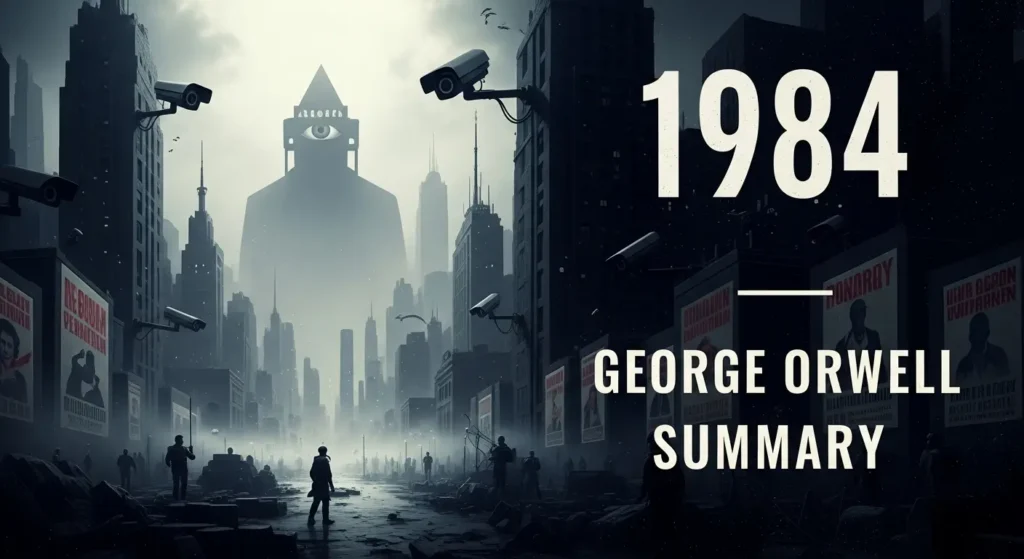
1984 by George Orwell is one of the most powerful and thought-provoking novels ever written. This 1984 George Orwell summary explores a world ruled by fear, control, and constant surveillance. Set in a totalitarian society where truth is rewritten and freedom is an illusion, Orwell’s story follows Winston Smith — a man who dares to question the system. The 1984 summary reveals how language, power, and manipulation shape human behavior and thought. More than just a dystopian tale, 1984 is a timeless warning about the dangers of losing individuality and truth in a controlled world.
1984 George Orwell Summary
What is 1984 about?
1984 by George Orwell is a powerful novel about a world where freedom, truth, and individuality are controlled by an all-seeing government. It shows what life looks like when people are watched all the time and even their thoughts are not their own. The story follows one man trying to understand himself in a system that demands total obedience.
The book takes place in a dark, future world where a political party rules everything. People are constantly monitored through screens, and even a simple expression can be dangerous. Orwell creates a society built on fear, control, and lies — a world where history is rewritten and facts no longer matter.
The main character works for the government, changing old records to match whatever the Party says is true. He begins to question why things are the way they are, and that quiet doubt becomes a silent form of rebellion. Through his eyes, we see how fragile truth can be when power controls everything.
One of the strongest parts of 1984 is how real it feels. The book doesn’t describe faraway planets or magic worlds — it describes a version of our own world, just taken to the extreme. The constant surveillance, the loss of privacy, and the rewriting of facts all feel disturbingly familiar even today. That’s why many people call Orwell’s novel “timeless.”
The writing is clear and sharp. Orwell doesn’t use fancy language — he uses simple words to describe very heavy ideas. Every scene feels tense and alive, like something that could actually happen. You don’t just read 1984; you feel it closing in on you.
Even without spoilers, it’s safe to say this book changes the way you see the world. It makes you think about truth, freedom, and how easily they can disappear. It’s not just a story about one man or one government — it’s a warning about how silence and fear can shape an entire society.
Reading 1984 is like holding up a mirror to the modern world. You begin to notice the ways power works, how truth bends, and how easily comfort can replace freedom. That’s why, decades after its release, the book still feels urgent, personal, and painfully real.
Spoiler Warning: This summary contains key plot details from the book.
1984 takes place in a grim future where the world is divided into three massive superstates — Oceania, Eurasia, and Eastasia.
These nations are constantly at war, but the alliances keep changing.
In Oceania, where the story happens, a totalitarian regime called the Party controls every part of life.
The Party is led by the figure of Big Brother, whose image appears on posters everywhere with the slogan, “Big Brother is watching you.”
No one knows if Big Brother is a real person or a symbol, but everyone is required to worship him.
The main character, Winston Smith, lives in London, now part of Airstrip One, a province of Oceania.
He works at the Ministry of Truth, where his job is to rewrite historical records to match whatever the Party currently says is true.
If the Party changes its mind about who the enemy is, Winston edits all newspapers and reports to erase any trace of contradiction.
The past is constantly rewritten so that the Party is always right.
It’s not enough to obey — people must believe.
This is the essence of the Party’s control.
Winston secretly hates the Party.
He is tired, lonely, and constantly aware of the telescreen in his apartment that watches his every move and listens to every sound.
Even facial expressions are dangerous because the Thought Police can detect disloyalty.
People live in fear of being vaporized — erased completely from history, as if they never existed.
Winston knows this, but he still begins to question everything.
He starts keeping a secret diary, an act punishable by death.
In it, he writes his true feelings about the Party and its leader.
He writes the forbidden words: “DOWN WITH BIG BROTHER.”
Winston knows he is doomed, yet writing the words gives him a small sense of freedom.
He feels that staying silent is worse than dying.
At work, Winston notices a dark-haired woman named Julia.
He first thinks she’s a spy because she seems loyal to the Party.
But one day, she secretly slips him a note that says, “I love you.”
This small act changes everything for Winston.
He and Julia begin meeting in secret, first in hidden corners and later in a rented room above an old shop.
The room becomes their private escape, a place where they can talk, laugh, and be human again.
They share simple pleasures — food, touch, and conversation.
In a world where love is forbidden, their relationship itself becomes rebellion.
Julia is more practical than Winston.
She doesn’t care about changing the system; she just wants to live freely within it.
Winston, on the other hand, wants truth.
He wants to understand how the Party gained such power and how it can be stopped.
He believes there must be others like him — people who remember a time before the Party.
Winston’s curiosity draws him to O’Brien, a powerful Inner Party member.
O’Brien seems intelligent and mysterious, and Winston senses a kindred spirit in him.
When O’Brien invites Winston to his apartment, Winston believes he has found a secret resistance.
O’Brien gives him a book written by Emmanuel Goldstein, the supposed leader of a rebel group called “The Brotherhood.”
The book explains how the Party uses endless war, economic control, and psychological manipulation to maintain power.
It says the Party doesn’t care about the good of the people — only about power itself.
“Power is not a means; it is an end.”
These words shake Winston deeply.
But Winston’s dream of rebellion collapses.
The Thought Police raid the rented room and arrest both him and Julia.
The old shopkeeper who rented the room turns out to be an informant.
Even their most private space was under surveillance all along.
Winston and Julia are taken to the Ministry of Love — a place of torture and re-education.
There, Winston learns that O’Brien was never a rebel.
He has been loyal to the Party all along.
O’Brien becomes Winston’s torturer, interrogator, and teacher.
He tells Winston that the goal of the Party is total control over the human mind.
It is not enough to obey Big Brother — one must love him.
O’Brien tortures Winston physically and mentally, breaking him down until he can no longer distinguish truth from lies.
The most terrifying moment comes in Room 101, where prisoners face their worst fears.
For Winston, it’s rats.
When O’Brien threatens to release the rats onto his face, Winston screams, “Do it to Julia! Not me!”
In that moment, he betrays the only person he truly loved.
The Party has achieved what it wanted — total domination over his will.
Afterward, Winston is released back into society, broken and hollow.
He meets Julia again by chance.
They both admit that they betrayed each other.
There is no love or rebellion left between them.
They are empty people, drained of emotion and thought.
In the final scene, Winston sits alone in a café, drinking Victory Gin and staring at a telescreen announcing a military victory.
He feels pride for Big Brother.
He no longer resists.
His independent thought is gone.
He realizes that he loves Big Brother.
Through Winston’s fall, Orwell shows how a government can destroy truth and individuality.
When a regime controls history, language, and even thought, there is no freedom left.
The novel’s world is terrifying because it feels possible.
Every slogan of the Party — “War is Peace,” “Freedom is Slavery,” “Ignorance is Strength” — is built on lies that people are forced to believe.
The story exposes how truth can be manipulated and how fear keeps people obedient.
1984 remains one of the most powerful warnings in literature.
It’s not just about politics — it’s about human nature.
It asks what happens when a society trades truth for comfort and freedom for safety.
Winston’s story ends in defeat, but his struggle to think freely reminds readers why independent thought matters.
Even in its darkest moments, the novel challenges us to defend memory, truth, and love — the last things that make us human.
1984 — George Orwell Detailed Analysis
This 1984 George Orwell detailed analysis dives into the novel’s craft — how its language, tone, and structure work together to create lasting impact. Orwell’s writing style is simple yet deeply unsettling, reflecting the cold and controlled world he imagined. Every word in 1984 feels intentional, showing how even plain language can carry powerful truth. The style and tone remain calm on the surface, but fear and tension run beneath every line.
Through its careful plot structure, the story moves from quiet doubt to complete despair, capturing the slow collapse of individuality. The characters, especially Winston, Julia, and O’Brien, are painfully real — flawed, conflicted, and shaped by their oppressive world. Orwell’s themes of truth, freedom, and identity make the story timeless, still echoing in modern discussions about power, control, and privacy.
The emotional impact of 1984 is heavy but unforgettable. Readers don’t just witness Winston’s struggle — they feel it. The originality of Orwell’s vision, from “Big Brother” to “Doublethink,” reshaped how we understand manipulation and truth. What makes this novel powerful is how personal it feels. The connection between reader and story grows stronger with each page, leading to an ending that breaks hope but leaves a lasting mark — a final reminder of what it truly means to lose oneself.
Language and Expression
Orwell’s language in 1984 is simple, sharp, and powerful. He avoids complicated words, which makes the story easy to follow yet deeply unsettling. Every sentence feels deliberate. The clear, cold tone matches the world it describes — emotionless and controlled. This simplicity makes the message even stronger. Orwell shows that plain words can carry heavy truth.
Style and Tone
The style is quiet but intense. Orwell doesn’t shout his ideas; he lets them grow in your mind. The tone shifts between hopeless and reflective, giving readers time to absorb the weight of what’s happening. There’s a calm rhythm in his writing, but beneath it lies constant fear. That contrast makes the story unforgettable.
Plot and Structure
The plot moves with purpose. It starts small — one man’s quiet doubts — and grows into a full rebellion of thought. The story is structured in three main parts: Winston’s life under control, his brief taste of freedom, and his total breakdown. Each part feels like a descent into darkness. The pacing is slow but meaningful, allowing readers to feel the tension building with every page.
Character Depth
Winston Smith is not a hero in the traditional sense. He’s weak, scared, and painfully human. That’s what makes him real. Julia adds warmth to the story — her defiance feels more practical, more alive. O’Brien, on the other hand, represents the terrifying logic of power. None of them are exaggerated. They act and think like real people caught in an impossible system.
Themes and Message
The main themes are control, truth, freedom, and identity. Orwell explores how easily truth can be manipulated when power decides what’s real. He questions what it means to be human in a world where even thoughts are watched. The book warns against blind loyalty, fake news, and the loss of privacy — issues that still feel current today.
Emotional Impact
Reading 1984 feels heavy. It’s not a story that comforts; it disturbs and challenges. The hopelessness of Winston’s world creates a deep emotional weight. You don’t cry because of one sad scene — you ache because the entire world feels lost. That slow emotional burn is what makes the novel unforgettable.
Engagement and Flow
Even with its dark tone, the story pulls you in. Each chapter raises new questions. You want to know if Winston will find a way out, even when you sense he won’t. The tension never disappears. Orwell’s balance between quiet scenes and shocking moments keeps the reader hooked from start to finish
Originality and Innovation
When 1984 was first published, there was nothing quite like it. Orwell created a world that felt both fictional and possible. Terms like “Big Brother,” “Doublethink,” and “Thoughtcrime” became part of everyday language — proof of how original the story was. The novel didn’t just invent ideas; it shaped the way we talk about power and truth
Reader Connection
Readers connect to 1984 because it feels personal. You see parts of your own life in Winston’s quiet fear — the wish to speak freely, to think freely, to live without being watched. The book builds an invisible bridge between its world and ours. That connection makes it more than a story; it becomes a reflection.
Impact of the Ending
The ending is devastating. Winston’s total surrender feels like the death of hope. Yet it’s exactly what gives the book its power. Orwell doesn’t offer comfort — he offers truth. The final lines stay in your mind long after the last page. You realize that the real horror isn’t the pain or the control — it’s the loss of self.
1984 — George Orwell Character Analysis
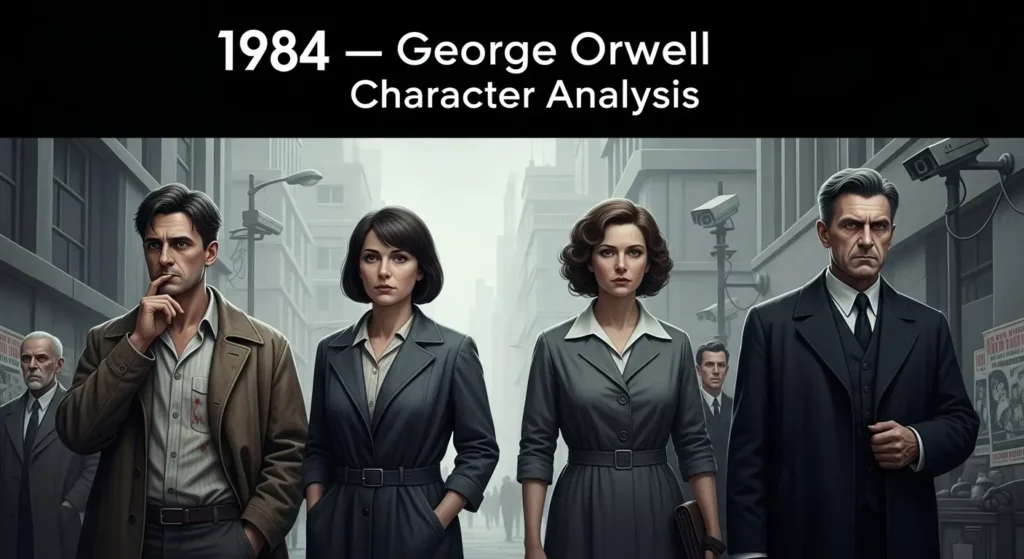
Who are the main characters in 1984 and what do they represent?
In 1984, George Orwell creates characters that feel painfully real. Each one reflects a different part of human nature — hope, fear, love, and control. The story wouldn’t work without them, because they show how power shapes people from the inside out.
Winston Smith
Winston Smith is the heart of the novel. He’s an ordinary man living an ordinary life under an extraordinary level of control. What makes him special is not his strength, but his quiet courage to question things. He works at the Ministry of Truth, rewriting history to match the Party’s lies, but deep down he knows something is wrong. Winston’s struggle is not just against the system — it’s against the fear inside himself. He wants freedom, truth, and love, even when he knows the price might be everything. Through Winston, Orwell shows how rebellion can begin as a single thought.
Julia
Julia brings color to the gray world of 1984. She’s younger, more impulsive, and more practical than Winston. She doesn’t dream of changing the system; she simply wants to live freely within it. Her rebellion is personal — a search for small pleasures and secret love. Julia’s courage feels real and raw. She knows how dangerous it is to care, yet she does it anyway. Through her, Orwell reminds us that resistance doesn’t always look like a revolution. Sometimes it’s just choosing to feel alive in a world built to kill feeling.
O’Brien
O’Brien is one of the most complex and disturbing characters in the book. At first, he seems like a friend — someone who understands Winston’s doubts and shares his hatred for the Party. But later, we learn he’s part of the Thought Police. His calm intelligence makes him terrifying. He doesn’t just punish; he explains why punishment must exist. O’Brien believes in the Party’s power completely. Through him, Orwell explores how ideology can destroy empathy. O’Brien isn’t cruel for pleasure — he’s cruel for belief, which makes him even scarier.
Big Brother
Big Brother is not a person you ever meet — he’s an image, a symbol. His face is everywhere: on posters, on screens, in the minds of citizens. He represents the idea of total control. People love him, fear him, and believe in him, even though he may not be real. Big Brother is the perfect tool of power — a presence that never dies, never doubts, and never forgives.
Mr. Charrington
At first, Mr. Charrington appears to be a kind, harmless old man who rents a room to Winston and Julia. His love for old songs and forgotten words makes him seem safe. But later, he turns out to be a member of the Thought Police. His betrayal is one of the most shocking moments in the book. Charrington’s character reminds us that in Orwell’s world, even trust is a trap.
Syme
Syme is Winston’s coworker at the Ministry of Truth, working on the Newspeak dictionary. He’s brilliant but blind to the danger around him. Syme believes in the Party’s language project — to shrink thought by shrinking words. His disappearance later in the story shows how quickly people can be erased when they know too much.
Parsons
Parsons is the perfect example of blind loyalty. He’s cheerful, proud, and completely devoted to Big Brother. He never questions the Party, even after his own daughter reports him for thoughtcrime. Parsons shows the danger of obedience without thinking — how easy it is to love the thing that destroys you.
1984 — George Orwell Reader Profile: Who Will Enjoy This Book?
Who is 1984 best suited for?
George Orwell’s 1984 is not a light or comforting read — it’s a story that shakes you, questions you, and stays with you long after the last page. This book is perfect for readers who like stories that make them think, reflect, and sometimes even feel uncomfortable.
If you enjoy novels that explore how power works, how truth can be twisted, and how the human spirit survives under control, 1984 will speak directly to you. It’s ideal for readers who appreciate deep, thought-provoking fiction rather than simple entertainment.
This book will especially appeal to:
- People interested in politics, philosophy, and society.
- Readers who enjoy psychological tension more than fast action.
- Those who liked books such as Brave New World by Aldous Huxley or Fahrenheit 451 by Ray Bradbury.
- Anyone who wonders how far governments or technology might go to shape our lives.
High school and college readers often meet 1984 for the first time in class, but the book feels very different when you read it as an adult. The older you get, the more you notice how close Orwell’s world feels to reality — how news, surveillance, and fear can still control us in modern life.
If you love dystopian stories with strong messages, 1984 is essential. But even beyond its genre, it’s a book for people who value freedom — not just political freedom, but the freedom to think, love, and doubt.
You don’t need to be a history or politics expert to understand it. Orwell’s language is clear, and his message is universal. What makes it powerful is how personal it feels. You start reading about Winston, but somewhere along the way, you start seeing yourself — your own habits, your own quiet fears.
Still, this book might not be for everyone. If you prefer stories with happy endings or clear heroes, 1984 can feel heavy. It’s a book that hurts before it teaches. But if you’re open to feeling that discomfort — if you like stories that leave a mark — you’ll find 1984 unforgettable.
Books to Read If You Loved 1984 — George Orwell
What should you read after 1984?
If 1984 left you thinking about truth, control, and the power of freedom, you’re not alone. George Orwell’s world stays in your mind, and it’s natural to want more stories that explore similar ideas. Here are some books that carry the same spirit — deep, emotional, and thought-provoking.
Brave New World — Aldous Huxley
Often mentioned alongside 1984, this book shows a very different kind of dystopia. Instead of fear and control, people are ruled by comfort and pleasure. Society looks peaceful on the surface, but freedom is quietly gone. If Orwell showed the nightmare of pain, Huxley showed the nightmare of happiness without meaning.
Fahrenheit 451 — Ray Bradbury
A classic about a future where books are banned and “firemen” burn them. The story follows a man who begins to question why knowledge is dangerous. Bradbury’s writing is poetic and emotional, and like Orwell, he reminds us how fragile truth can be.
The Handmaid’s Tale — Margaret Atwood
Atwood’s world is built on control, especially over women’s bodies and rights. It’s a chilling and beautifully written story about power, faith, and resistance. Readers who loved 1984’s emotional weight and social criticism will find this book just as powerful.
Animal Farm — George Orwell
If you haven’t read Orwell’s other masterpiece, you should. On the surface, it’s about animals starting a revolution, but underneath, it’s a sharp look at corruption and hypocrisy in politics. It’s shorter than 1984 but hits just as hard.
Never Let Me Go — Kazuo Ishiguro
This quiet, emotional novel explores what it means to be human in a controlled world. The story unfolds slowly, with a haunting sadness that stays long after you finish. Like 1984, it questions freedom, love, and what it means to have a soul.
The Trial — Franz Kafka
Kafka’s work inspired much of Orwell’s tone. In The Trial, a man is arrested and prosecuted by a mysterious system he doesn’t understand. There’s no clear reason, no escape, and no answers – just endless confusion. If you liked the feeling of unease in 1984, you’ll find it here too.
We — Yevgeny Zamyatin
Written before 1984, this novel actually inspired Orwell. It describes a future where everyone lives in glass houses and individuality is forbidden. Zamyatin’s ideas shaped the entire dystopian genre, making it a must-read for anyone who wants to see where 1984 began.
Interesting Facts About 1984 — George Orwell
Did you know these surprising facts about George Orwell’s 1984?
Even decades after its release, 1984 remains one of the most discussed and quoted books in the world. Behind its pages lie many fascinating stories — from how Orwell wrote it to how it still shapes our world today.
The original title wasn’t “1984”
Orwell almost named the book The Last Man in Europe. He changed it to 1984 just before publication, possibly to make it sound more direct and memorable. Some believe he simply reversed the year 1948, when he finished the novel, to suggest a near-future world rather than a distant one.
Orwell wrote the book while seriously ill
George Orwell wrote 1984 while battling tuberculosis. He lived on the remote Scottish island of Jura, writing in isolation under harsh weather conditions. Despite his illness, he pushed himself to finish the manuscript — a real reflection of his commitment to truth and freedom.
Big Brother was inspired by real propaganda
The image of Big Brother was influenced by wartime posters that said “Big Brother is watching you.” Orwell mixed that style of government messaging with his experiences watching political manipulation during World War II and the rise of totalitarian regimes.
The word “Orwellian” entered the dictionary because of this book
1984 was so influential that it created a new adjective: Orwellian. It’s used to describe situations where governments use surveillance, censorship, or control over truth — exactly like in the novel.
The book introduced words we still use today
Terms like Big Brother, Doublethink, Thoughtcrime, and Newspeak all come from 1984. These words have become part of everyday language, used in politics, media, and technology to describe real-life control systems.
Some governments banned it — others used it as propaganda
Ironically, both sides of the political spectrum have censored or used 1984 to support their own messages. It was banned in the Soviet Union for criticizing totalitarianism, but also challenged in the U.S. during the Cold War for being “anti-government.” Orwell’s warning applied to everyone.
The ending shocked early readers
When 1984 was first published, readers were stunned by its bleak ending. Many expected Winston to win against the system, but Orwell refused to offer hope. He wanted the book to feel real — a warning, not a comfort.
Orwell predicted modern surveillance
Cameras on every street corner, government monitoring of communication, and the rewriting of information — Orwell imagined them long before the internet. His vision of a world built on control feels more relevant now than ever.
There’s no clear answer about the year “1984”
Readers often wonder if the story truly takes place in the year 1984. Orwell never confirmed it directly. Instead, he used the title as a symbol — a future that’s always close enough to be possible.
The book was almost lost to time
After finishing 1984, Orwell’s health collapsed. He died only seven months after the book’s release. He never saw how famous it became, or how it would shape generations of readers.
1984 — George Orwell Rating
How does George Orwell’s 1984 score in key literary aspects?
Here’s a closer look at how the novel performs across major elements that define a powerful reading experience.
Plot and Narrative Structure
The plot of 1984 is perfectly built — slow, steady, and suffocating in the best way. Orwell creates tension not through action, but through silence, fear, and the feeling of being watched. Every part of the story serves a purpose. The structure — from Winston’s quiet doubts to his complete collapse — feels natural and inevitable. It’s a masterclass in building psychological pressure without losing clarity.
Character Depth
The characters are not many, but each one carries real weight. Winston is deeply human — fragile, brave, and painfully aware. Julia adds warmth and rebellion. O’Brien, on the other hand, is complex and terrifying. Still, some readers may find the emotional distance between characters intentional but cold. Orwell focuses more on the idea than on personal intimacy, which fits the story but limits emotional connection slightly.
Emotional Impact and Connection
Few books hit as hard as 1984. It doesn’t make you cry in one scene — it makes you feel uncomfortable for the entire journey. The emotional impact comes from the constant tension and the slow loss of hope. When Winston finally breaks, you feel it too. The book doesn’t comfort; it unsettles. And that’s exactly what makes it unforgettable.
Language and Style
Orwell’s writing is simple, precise, and brutally effective. He doesn’t decorate his sentences. He cuts straight to the truth. That clarity makes the horror of his world even sharper. The language of 1984 also created new words that became part of global culture — “Big Brother,” “Doublethink,” “Thoughtcrime.” Few writers have shaped language itself the way Orwell did.
Originality / Author’s Voice
1984 remains one of the most original and daring novels ever written. Orwell’s ability to predict modern politics, surveillance, and media manipulation feels almost prophetic. His voice is calm but urgent — never dramatic, yet deeply emotional. The novel doesn’t just tell a story; it defines an entire way of seeing the world.
1984
-
Plot and Narrative Structure
-
Character Depth
-
Emotional Impact and Connection
-
Language and Style
-
Originality / Author’s Voice
Summary
1984 stands as one of the greatest literary warnings ever written. It combines a chilling vision with emotional depth and flawless storytelling. Even decades later, its message still feels fresh, urgent, and painfully real.
1984 — George Orwell General Evaluation
Why does 1984 still matter today?
George Orwell’s 1984 is not just a story — it’s an experience that changes the way you look at the world. It’s one of those rare books that feels more like a mirror than a novel. Every time you read it, you notice something new about power, fear, or truth.
What makes 1984 so powerful is its honesty. Orwell doesn’t exaggerate or hide behind complex ideas. He takes something simple — the need for freedom — and shows what happens when it disappears. The world he builds feels distant and familiar at the same time, which is why it still feels relevant, even decades later.
The book doesn’t promise hope. It leaves you uneasy, asking questions instead of giving answers. But maybe that’s the point. Orwell didn’t write 1984 to comfort us — he wrote it to wake us up. To remind us how fragile truth can be, and how silence can be just as dangerous as lies.
Reading 1984 today feels like reading a warning written for our own time. Surveillance, misinformation, and the manipulation of truth are no longer fiction. That’s what makes Orwell’s message so timeless. His words stay sharp because the world keeps proving them right.
As a novel, 1984 is brilliant in every sense — emotionally heavy, intellectually sharp, and artistically simple. It’s not an easy read, but it’s a necessary one. Every sentence has purpose; every scene carries weight. You finish it feeling both empty and awake.
In the end, 1984 isn’t just about Winston or Big Brother. It’s about us — how we think, how we obey, how we choose truth over comfort. And that’s why it remains one of the most important books ever written.
What is 1984 about?
1984 summary: The novel tells the story of a totalitarian society where the government, led by Big Brother, controls every aspect of life. It follows Winston Smith as he struggles to think freely and challenge the system.
Who is Big Brother in 1984?
Big Brother is the figurehead of the Party and symbolizes absolute government control. He watches over citizens constantly, using fear and surveillance to maintain power.
What are the main themes of 1984?
Key themes include control, censorship, truth manipulation, individuality, and the conflict between freedom and oppression. Orwell explores how power can shape reality and human thought.
Why is 1984 still relevant today?
The book highlights issues like mass surveillance, fake news, and loss of privacy, which continue to resonate in modern society. Its warnings about power and manipulation feel timeless.
Who are the main characters in 1984?
Winston Smith is the protagonist, a man quietly rebelling against control. Julia represents love and defiance, while O’Brien embodies the terrifying logic of authority and manipulation.
What happens at the end of 1984?
Spoiler alert: Winston ultimately surrenders to the Party. His rebellion fails, showing the overwhelming power of totalitarian control and the loss of personal freedom.
What is the significance of “Doublethink” and “Thoughtcrime”?
These concepts illustrate how the Party controls minds. Doublethink is holding two contradictory beliefs, and Thoughtcrime is even thinking against the Party — showing how deeply oppression can invade thought.
How does Orwell’s writing style affect the story?
Orwell’s simple, precise language makes the world feel cold and controlled. The quiet, tense tone amplifies the emotional impact, making readers feel Winston’s fear and hopelessness.